Here are a selection of photos taken of the Norman parts of York Minster that may be useful resources for classwork. Descriptions of what they are are underneath. If you need information about York Minster and church history across any period do contact Alex O’Donnell from the Minster learning team via alexod@yorkminster.org. The team will be happy to help with staff knowledge updating and/or work with students from Key Stage 1 through to A Level. They have a lot of information on the Minster in the Tudor Reformation period that may be very useful for some of us.
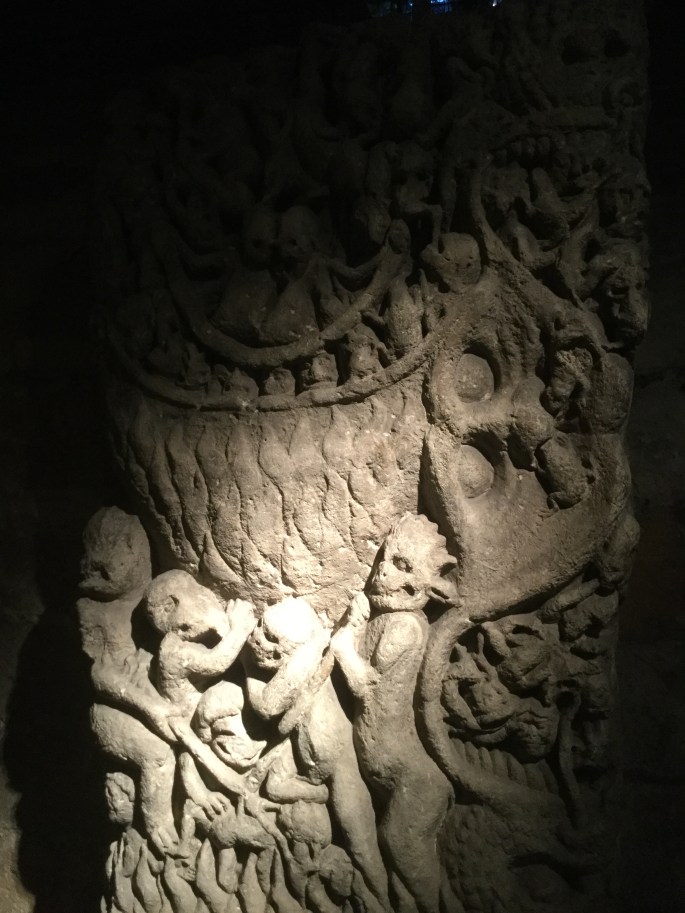
The Doomstone: this would have originally been on the front of one, or possibly both, of the Norman York Minsters. It would have given a clear message to worshippers about what awaited them if they did not lead a godly life and that they needed the church. There would also have been a depiction of heaven, but this is lost. It would have been brightly painted. If you look carefully you can see devils and the mouth of hell as a cauldron. There are also toads emerging from nostrils!
The remains of a statue of the Virgin and Child is early Norman. It may have been defaced at the Reformation, or in order to use it as core stucture material.
There are two lovely examples of Norman pillars. One of them has no top and so you can clearly see how the pillars, while beautifully faced, were packed with rubble.
The weathered figures are probably apostles and they would have been on the outside of the Norman cathedral(s).
Why two pictures of brick walls? Well, the first is built of millstone grit. It’s re-cycled Roman stone. The Minster was, and is, built of local Tadcaster limestone, whereas the Romans used gritstone for their forum, which was on the site of the Minster. Gritstone is tougher than limestone and the Norman builders took full advantage of all the Roman remains in the area to use the gritstone to build strong foundation walls. Clever folk those Normans! The second wall picture shows herring-bone pattern. It is typical of Anglo-Saxon building and reminds us that Norman masters had Anglo-Saxon workmen building their cathedrals and churches.
The top of the column is richly carved and still has some remains of red paint on it. It is not unlike a rough classical column and the Norman architecture style is known as Romanesque in the rest of Europe.
The stained glass is Norman, which makes it some of the oldest that survives. It would have been part of a window in the Norman cathedral(s).
The small piece of stone (in the plastic box!) is actually very valuable. It is a fragment that shows how Normans painted their churches white and then painted on red false mortar lines. This is a rare surviving fragment of what would have been a very common scene in Norman England. Possibly the white painting made buildings stand out as very rich and important.
The Minster Learning Centre staff can explain how the Norman cathedrals developed with their handy model!



 yorkclio