Teaching bigger history – great free resources!

Huge thanks to Dan Nuttall and Laura Goodyear for sharing their resources with everyone in the history teacher tribe. We are really pleased to publish the link here. People at the HA’s recent Yorkshire History Forum were able to hear them explain their work. If you missed it, do get in touch with Dan and he will happily explain the thinking behind these resources in more depth.

Frameworks and teaching bigger history
The link below will take you to five units that all deploy a frameworks approach as a method for teaching big/bigger history. The units cover:
– Big History (covering the development of humankind from hunter-gatherers to the present). Eight KS3 lessons with resources.
– C20 international relations. Seven KS3 lessons with resources.
– Power and the monarchy c.1000-present. Eight KS3 lessons with resources. Could be adapted for GCSE Power and the People.
– Big History of slavery (from Palaeolithic to the present). Seven KS3 lessons with resources (intended to be taught as well as, not instead of, transatlantic slavery).
– France 1776-1830. A framework with diagrams, not a complete unit, for A Level.
These are shared to encourage further experimentation and discussion into the ways in which students can be taught to comprehend larger scales of time, and thereby develop greater historical consciousness.  Please see the ‘Further reading’ bibliography.
Please feel free to share with colleagues and the wider history teaching community.*
Feedback and discussion more than welcome, to danielnuttall1981@gmail.com.
Thanks and happy experimentation!
Dan Nuttall
* – no commercial use please without permission.
– please credit the authors. ‘Power and Monarchy in Britain’ unit by Rick Rogers and Dan Nuttall. ‘France 1176-1830’ by Dan Nuttall, images by Laura Goodyear. ‘C20 International Relations’ by Dan Nuttall, images by Laura Goodyear. ‘Big Story of Us’ by Rick Rogers (framework/grid), Laura Goodyear and Dan Nuttall (lessons and resources). ‘Big History of Slavery’ by Denis Shemilt (framework), Laura Goodyear and Dan Nuttall (lessons and resources).
– I do not own copyright for any images that may be contained within the resources.


The Old Lady in the Post Office – how to teach writing a strong line of argument to any key stage

Screenshot (253)

If you’re finding it difficult to teach students in any Key Stage what an argued piece of writing that offers a substantiated judgement looks like, you need to meet someone. She’s called the Old Lady in the Post Office and nothing I’ve tried has been more effective in helping students understand what a line of argument looks like when it runs throughout an essay. Here is the monologue as a PPT: The Old Lady in the Post Office . It has a screen and handout version.

Inspired by the work of Daisy Christodoulou, and her argument that we can teach and formatively assess specific elements within longer pieces of writing, the Old Lady is an attempt to characterise the line of argument, helping students self- and peer-assess this particular element of writing judgement essays in History.

The task is simple – the student with the best ‘Old Lady’ voice reads out the argument and the other students have to identify the core problem she has with the Post Office. They can then identify how she acknowledges subsidiary factors and how she brings them into her argument and builds her opinion from start to finish.

Once they have done this ten-minute task, they are able to identify the line of argument in their own and other essays by answering questions like ‘Can you ‘hear’ the Old Lady coming through?’ and ‘Has she got a clear answer to this question?’ Consequently students are far quicker at identifying their own and other lines of argument.

Bonus Tip 1: To exemplify a ‘real historian’ doing this, look no further than The Old Man in the Army Uniform. He can be found presenting an argued case about the causes of the American Civil War on YouTube for Prager University. (YouTube clip)

Bonus Tip 2: This characterisation of a line of argument as the ‘Old Lady in the Post Office’ is showing promising signs in the task of analysing written interpretations and looking for the overarching interpretation. It seems particularly useful for distinguishing between the interpretation and the evidence offered in support of it.

Hugh Richards

for YorkClio in Feb 2018

Madeleine Blaess’ diary: York woman in Nazi occupied Paris

This is a developing project. Madeleine Blaess was born in France, but grew up in Acomb and went to the Bar Convent School (now All Saints). She was trapped in Paris during the Nazi occupation and wrote a diary recording everyday life under occupation. She managed not to be interned, by pretending to be French. Two of her friends were murdered in Auschwitz. After the war she was an academic in Medieval French Literature at the University of Sheffield. The diary was revealed among her papers, which she left to the university when she died in 2013.  This was left to the University of Sheffield at her death.

The University of Sheffield are working on these papers and the diary is shortly to be publisned open access at White Rose University Press (which itself is something YorkClio folk should know about!) There is also a 35 minute film on its way.

This promises to be a fantastic way for York History and French teachers to connect a local story to a much bigger story that is commonly taught. We hope to develop the connection with this project further.

When did William conquer England?

Now there’s a big question for a Friday afternoon! Attached here are a couple of resources that you can use to help students decide. Hugh, who developed these, recommends a dramatic intro for each scenario:

  • Was it when he was out of breath on the top of Senlac Hill?
  • Was it as he sat smugly in the charred remains of York Minster?
  • Or was it…?

Students create a situation report for each scenario. When did William Conquer England

And, in case you need it, a crib sheet to get you started: MASTER – When did William Conquer England

AQA GCSE revision materials

Picture1-750x430A HUGE thanks to Henry Walton and the Manor CE Academy team for sharing their revision notes and knowledge tests for their AQA modules. Henry has more detailed notes he can share locally if you get in touch with him.
Conflict and tension MQTs combined

WW1 Revision sheets combined

USA MQTs combined

USA Revision sheets combined

Ed I revision sheets combined

Medieval England MQTs combined

PatP MQTs combined

PatP revision sheets combined


World War One in the local area free resources

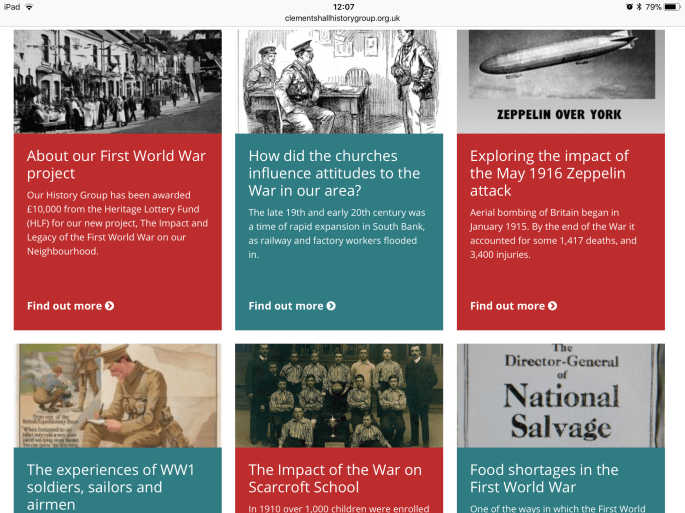
We are so lucky in York to have active and inspired local history societies. The Clements Hall Local History Group have had a lottery grant for their local World War One project. They have used it so brilliantly! The research they have done has all been published online – though there are also some hard copies of certain booklets. We can share it with you here: Clements Hall LHG World War One resources This site really is worth a look for all history teachers, but especially those around York. You will find films about a zeppelin raid and conscientious objectors. There are first hand accounts from soldiers, sailors and airmen. The role of women is explored. There is detail about how local churches, schools and organisations got through the conflict. There is also a lovely section on the Rowntree memorial Park. You can see the Quaker influence in the memorial text and it would make a lovely intro to the mood with which many greeted the founding of the League of Nations.

This park and the adjoining playing fields were given to the city by Rowntree & Co. Ltd to the memory of those members of the company’s staff who at the cost of life and limb or health and in the face of inconsiderable suffering and hardship served their country in her hour of need. Many were inspired by the faith that this war might be the end of war – that victory would lead to an enduring peace and to greater happiness for the peoples of the world. The creation of the League of Nations will be a fitting crown to the faith and hope of the men who have fought and a true memorial to their endurance, heroism, comradeship and sacrifice.”

Do have a look elsewhere on the site for other nice local history resources that would be useful for a KS3 history club.

Fulford, Fishergate and Heslington Local History group are also tracing all the men on four of their local war memorials. They have also done some work on the military buildings in their area. Here is their link: FFH Local History Group WW1

We are really grateful for all the time, effort, enthusiasm and skill that has gone into putting these resources together.

Picturing the Past

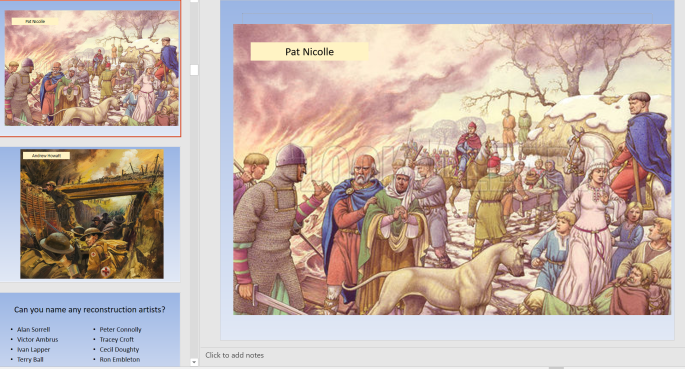
Michael Riley shared with us wonderful historical illustrations and many ideas about how to use these as historical interpretations in our classrooms. His Powerpoint and handout are here: Picturing the pastPicturing the Past handout

Teaching the Domesday Survey

Ruth Lingard and Helen Snelson from Yorkclio worked with Professor Stephen Baxter from the University of Oxford to develop resources for teaching about the Domesday Survey. The attached resources are adaptable for Key Stage 3 or GCSE and the whole lot can be done in one lesson. The story of Domesday is so exciting and some of this can be missed by students. These trialled and peer-reviewed activities should solve that problem!

Resources for learning about the Domesday Survey and the challenge facing the scribes: How revealing of Norman skill is the Domesday Survey  The first part of the story of the Domesday Survey   Eight wapentakes  Ten landholders

Resources for learning about what Domesday Book reveals about the Conquest: What can Domesday reveal re Conquest  PPT people and places on map  What can Domesday reveal places   Sheets on which to collate findings

If you want to catch up on the latest research about the Domesday Survey – here are some notes: Domesday Book

Update: huge thanks to Tracy Bowen who has adapted these resources for her Y7 students with low-levels of literacy. If you stick these A3 posters up around the room: Domesday Book Differentiated activity , students can then use them to collect the info onto this chart Domesday Book Survey – Differentiated . Here is the PPT that fits around it and sets up the lesson: Domesday Book – Differentiated Activity .

Follow this link: @HistoryBreeze  to nice examples of data capture sheets developed for use with the main activity. Thanks for sharing, colleagues!


Are you studying Hardwick Hall as part of the AQA GCSE course 2016-18?

Here are free resources for anyone studying Hardwick Hall as part of the Elizabethan depth study for AQA GCSE.

The pack is a mash up and more of the AQA resources. It is designed to introduce the historic environment study, has some preparation ideas and is then a workbook to use on site. Teaching pack

Here is a VR tour of the Hall for use by anyone who can’t get there, and also useful for revision. VR tour of Hardwick Hall

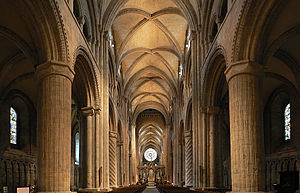
Are you studying Durham Cathedral as part of the AQA Norman England Unit?

Last week we were lucky enough to be joined by research Assistant Dr. John Jenkins from York University for an hour session on the Normans and Durham Cathedral. Here is a brief transcript of what he told us.  Please share with any colleagues studying Durham Cathedral for their Historic Environment.

  1. Durham is unique in that it combines the role of Church and warrior bishop. The Earls of Northumbria had not been successful in ruling over the people. Tostig had been replaced by Harold, Copsi had been given the role by William but lasted only 5 weeks in the job until he was burnt out of his church and beheaded. He was killed by Oswulf, grandson of Uchtred, who installed himself as Earl. Oswulf was killed in the autumn by bandits after less than six months as Earl. The role then passed to Gospatric who later joined a rebellion with Edgar Atheling and the Danes. As a result of this rebellion William stripped him of his title and placed Waltheof in the role. In 1075 Waltheof is caught up in another rebellion against William, and, despite confessing he is executed by William.

Clearly the Earldom of Northumbria was causing major problems for any English King.

Why?

John explained you need to understand that the people of Northumbria felt they owed their allegiance to a higher authority than a King. They were the ‘people of St. Cuthbert’. St Cuthbert had been a monk at Lindisfarne and Melrose in the 7th Century and had been given the status of Saint. His remains had been moved across the North of England in reaction to various Viking invasions but by the 10th Century he was firmly established at Durham Cathedral. The people of Northumbria identified themselves as ‘waliwerfolc’ – essentially People of the Saint. This means that St. Cuthbert was their protector. In the Harrying of the North, Simeon reports that the Normans turn back at Northallerton because Cuthbert has sent down a mist.

Durham was not any use in the strategic sense. Instead the Normans build Newcastle as this is a much more useful strategic position.  However Durham has significance as a religious site. According to the Anglo-Saxon Chronicle, William visits Durham and goes to the shrine of St. Cuthbert. Here he confirms all the liberties and lands of the cathedral and gives gold and vestments.

Simeon gives an alternative story in which William doubts whether Cuthbert is really in the tomb and tries to open the coffin. At the moment he does he is stricken with fever and rides away in terror. He then sends gold.

John points out that it really doesn’t matter which was true, it was an idea that was believed by the people of Northumbria. William had realised that in order to control this region he had to respect their Saint.

The Normans decide to launch a new style of Earl/Bishop for a variety of reasons

  1. Bishops have no children as they are celibate so they can be easily removed without hereditary issues
  2. To make the job attractive there needed to be significant reward
  3. The Earls needed to use the powers of St Cuthbert to be able to govern
  4. The Earls needed considerable power – could offer rewards of monastic life to the sons of families who obeyed their laws.

William St Calais is the first of these new Bishop Earls

The Cathedral at Durham is rebuilt alongside the existing Anglo- Saxon one (called the White Church). Cuthbert’s remains are transferred in 1104. They also build a new monastery.

The new cathedral would have been built by a team of Norman stone masons and used the newest fashion for ceiling vaulting. The zig zag motive represents continuity with the old Anglo-Saxon style of decoration. (The Normans decorated much more figuratively). It was exactly the same length as St Peters in Rome. It would have been painted red, blue and green inside and probably white outside.

12 monks looked after Cuthbert and some could trace their lineage back to the 7th century Lindisfarne. (Monks at this point were not celibate)

William St Calais comes from a monastery in Normandy and he models Durham on this experience. William brings in Benedictine monks who are stricter and observe the rules of celibacy. In this way he takes over control over Cuthbert’s staff. Future monks have to observe celibacy.

Before 1083 women could also pray at the shrine of St. Cuthbert. William brings in strict rules based on his former monastery’s practise of denying women access to the shrine. Women end up pressing offerings into the walls or having to give them to the monks in an attempt to get close to the saint. Teachers could link this to wider changes in the diminishing status of women in the Norman period?

Durham Castle – it was small and never really used in battle. Not much of the original castle remains now. It was built in 1070 as the Bishop’s Palace and like all castles was largely symbolic. It would have been a simple motte and bailey and a curtain wall. John pointed out that the AQA pack showed photos of the later parts of the cathedral and castle. You will need to get students to cross out lots of the visible outline to give a true impression of how the castle  and cathedral would have looked in Medieval times.