New resources about York’s medieval Jewish community and life before the Romani Genocide

As Holocaust Memorial Day is approaching we are sharing these resources we have created related to Jewish and Roma/Sinti history. Actually, they are resources you can embed into your curriculum and teach at any time.

York’s Medieval Jewish community

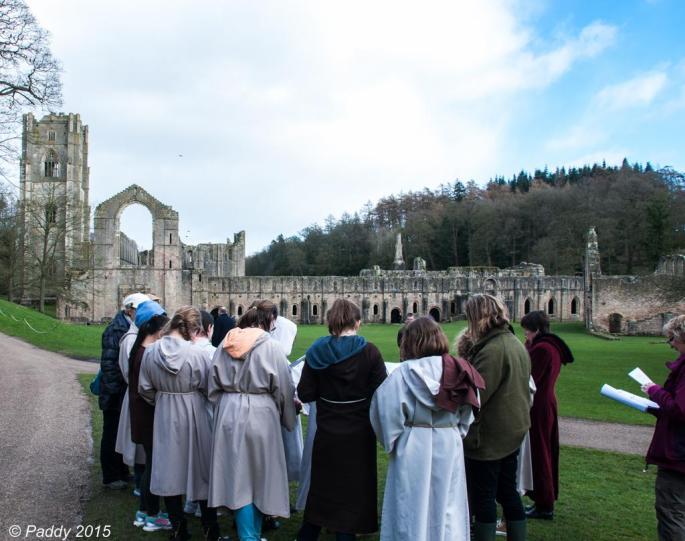
Working with historians at the University of York, we have created this resource Padlet. It shares recent scholarship that has revealed new knowledge about York’s 13th century Jewish community – after the terrrible massacre of 1190. It suggests how you could work with this material in class. It also provides images, maps and other useful links. This is medieval English history as much as Jewish history and the new material shows how integrated the York’s Jewish citizens were at the time.

Life before the Romani Genocide

It is established good practice to teach about life before the Holocaust, so that European Jewish people are not presented just as victims. This PowerPoint has been created so that the same can apply when teaching about the Romani Genocide. In a short amount of lesson time, pupils can learn something of the vibrancy of Romani people before the genocide and the many ways that they were part of European life in the early 20th century.

Alford Gardner: WW2, Windrush & Yorkshire

Alford Gardner’s story is rich material for the history classroom. His story connects Yorkshire to the Windrush story, from 1948 to present day. It presents a narrative arc of Britain in WW2 to the present. Here is a Padlet of resources and suggested approaches to using Alford’s story in the classroom.

Made with Padlet

Stories of slavery, abolition, industry – York and area

Thanks to the University of York Borthwick Archives and Professor Jim Walvin, we have been focusing on York and area in connection with slavery, abolition and industry. This complex topic could be approached using a local focus. To help teachers, here is a Padlet of ideas, knowledge and resources to help with planning and teaching. There are:

  • Resources relating to the two people who lived in York having been compensated for owning enslaved people – they are on the UCL Legacies database.
  • Images from the Harewood Lascelles archive.
  • Clips of Prof Walvin giving perspectives on abolition.
  • A story from letters by a methodist missionary on Nevis at the time of abolition.
  • Maps, timelines and images
  • A short reading/listening list for busy teachers.

Please do let us know if there is anything you would like adding to this. The intention is not to replicate what is elsewhere, but to keep a specific local/ new focus.

Teaching a more representative and coherent British 17th Century

Ruth Lingard and Helen Snelson have presented their work on teaching a representative and coherent British 17th century for the HA at the 2021 Virtual Conference. All the resources accompanying the session are free to download from this blogpost.

You can find the link to a folder of all the resources here. In the folder you will find life stories of people who lived in the period 1625-1714 written in the first person. Some of them are names that are more popularly known, others are less familiar. For each person there is an accompanying worksheet. There is also a summary of the 16 stories and a suggestion for a summary activity. All the resources can be downloaded and adapted. Some exemplars of stories adapted for SEND have been provided. The resources as presented can be used to teach a coherent overview of the period in 2-3 lessons. This might be, for example, to bridge between topics, or prior to a depth study on a particular aspect of the period. However, colleagues may decide to use just a few stories, or parts of stories, and they could be used at the end of a depth story.

The enquiry question that frames these stories could be ‘What matters about the 17th Century?’ That is, what mattered to people at the time and what matters were they concerned with. The first person stories written as narratives enable pupils to be introduced to key knowledge about the period 1625-1714, including:

  • The importance of religion to people’s lives, the way it divided people and how that drove a civil war and its aftermath.
  • The impact of a civil war on all the people and the country, both at the time and its legacy.
    The impact of England’s growing trade and settlement of the Americas, as a place of emigration, domination, hope, horror and change.
  • The substantive concepts of power, parliament, monarchy, liberty, rule of law and how they develop in this period.
  • The interplay of science and religion – new understandings of space and time.

The stories are diverse in their range of place and people. (For example, the people whose stories they tell lived in different parts of the UK and beyond, lived across the time period, had different backgrounds and roles in society.) They enable an exploration of relationship, in its widest sense, and they avoid oversimplification of a complex world. History stays messy!

Stories are popular with history teachers – they are engaging and ‘sticky’ – but they can be problematic. Sometimes a story can be so powerful that it makes a broader, deeper and richer understanding more difficult. For example, the story of the assassination at Sarajevo that sparked war in 1914 can take up too much space in students’ minds when they are trying to make sense of what caused the First World War. For example, perhaps the key stories of Rosa Parks’ bus ride and Martin Luther King’s speech, while rich and important in themselves, have hindered a more nuanced understanding of the struggle US Civil Rights’ struggle of their period? For example, a focus on the killing of Wat Tyler at Smithfield obscures the more complex story of the People of 1381 and can make it harder to make meaning about the greatest uprising in England (and some historians assert Tyler didn’t even exist!). We do need to be careful with story. However, stories which are carefully crafted to lead our students to a wider and deeper understanding of people and place can be very powerful teaching tools. The stories here are crafted so that they, hopefully, do some of that. The stories are not inward looking, they reach out to the wider issues. That means that they are not written in a way that only includes what is exactly known about the people and their concerns. They also include detail that is historically accurate about the places, events and cultures that existed around these people. It is in this way that they help students to think about what matters about the 17th century and to learn what mattered to its people.

The stories are also rich in the disciplinary concepts of change, and similarity and difference. The stories introduce many people, but the ‘lead’ characters are more likely to be people from more privileged positions. This should be brought to the attention of pupils. It will enable teachers to draw out issues relating to the fragmentary nature of what survives to us from the past and how this can shape our sense of who and what is historically significant. The meaning that people in the 17th century gave to their lives may sit oddly with 21st century popular perceptions of what was significant in British history from that period. By raising these issues with pupils we can explore the silences and the gaps in our knowledge.

We hope these resources will be useful and that they will also serve to increase teacher, as well as pupil, knowledge of the period 1625-1714.

Update October 2021: huge thanks to Natalie Kesterton for adding a PDF of two lessons and SEND materials to the Drive folder!

Turning the world upside down: teaching the 17th century so that all voices are heard

This is where we will post the first person 17th Century Stories over the next couple of months.

Mary Belasye, Countess Falconberg

Isaac Newton

More coming soon!!!

If you are interested in other sets of first person resources, there are some from 1945-49 available here: historiana.eu

Teaching a history of mental health to improve thematic understanding in a packed curriculum

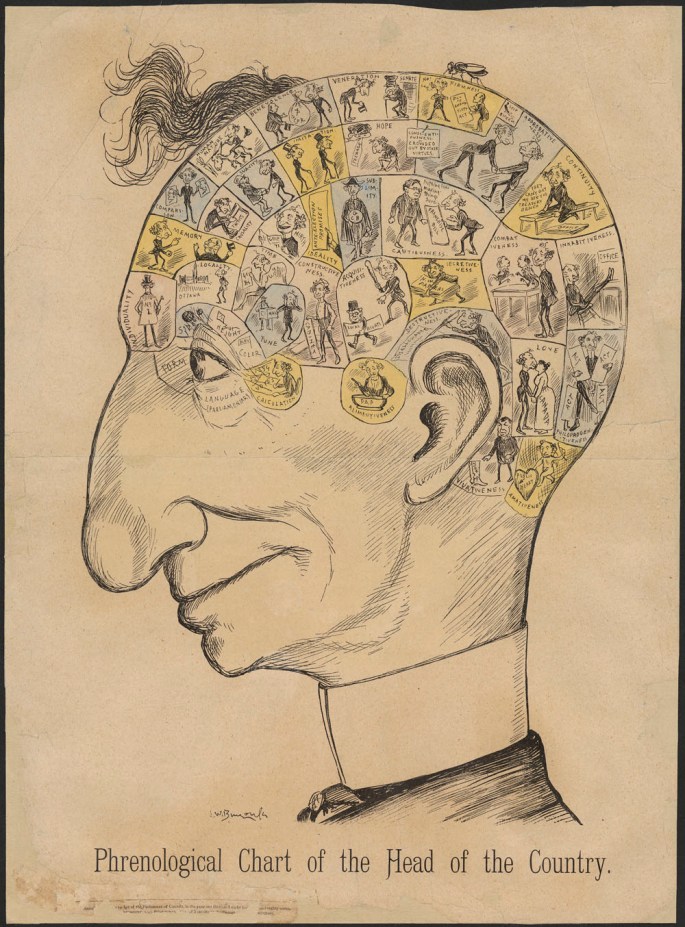
Following on from our work that featured in TH 173 about teaching a history of people with disabilities, we have focused our recent development work on resources for teaching about mental health in the past. Here are the resources that we presented in our session at the HA conference in Chester in May 2019. This work is ongoing and we are also working with colleagues in the Netherlands. It would be great if other people would like to get involved.

Resources are provided here for a single lesson with the EQ: How differently have people viewed mental health?

We have a moral duty to reflect the diverse past in our classrooms and the Equality Duty Act of 2010 requires us to eliminate unlawful discrimination, harassment and victimization, advance equality of opportunity between different groups and foster good relations between different groups. Respecting the past of everyone is part of fostering this.

From this lesson we want students to learn that:
• Mental health has a past and therefore a history
• Ideas of what constitutes mental illness and health have changed over time
• Ideas of what causes and the treatments for mental illness have changed over time due to these changing ideas, but also other cultural and societal changes.

It could be taught at the start of GCSE or as a KS3 study to encourage conceptual understanding of change over time (thematic).

The resources you need are here:

There are also a selection of slot-ins on the YorkClio slot-in page.

The starter images are here:

Where can I find…?

This pinned post is a handy guide to the resources in this section. Each resource is hyper-linked from here:

Resources in time order:

Planning and ideas and displays:

KS3/GCSE and A Level topic resources

Narratives to build chronological understanding and fill in the gaps

Natalie Kesterton, Head of History at Ryedale School and Chartered History Teacher, has developed several approaches to building chronological coherence in the KS3 curriculum by filling the gaps in the story – the bits we don’t have time to teach. She came to the University of York History PGCE mentors’ meeting and shared her ideas so far. This work is being written up for Teaching History and will be featuring in the SHP and HA conferences, so we were lucky to get a preview. Her work supports the development of students’ chronological understanding and helps them to join up the different depth studies by identifying the big themes.  Natalie has kindly shared her resources so far:

final 1660-1750 narrative DIFFERENTIATED X2 

final 1660-1750 narrative DIFFERENTIATED

final 1660-1750 narrative DRAFT THREE

Narrative 1216-1348 DRAFT THREE DIFF needs work

Narrative 1216-1348 DRAFT THREE

Which King 1087-1199 DRAFT THREE DIFFERENTIATED

Which King 1087-1199 DRAFT THREE DIFFERENTIATEDx2

Which King 1087-1199 DRAFT THREE

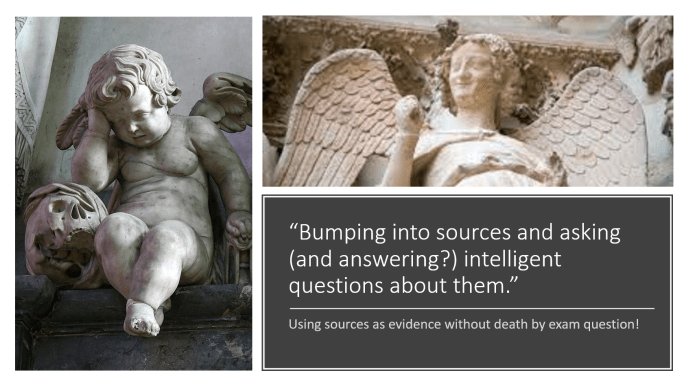
Bumping into sources!

Here is a PPT and some thoughts about using sources as evidence at KS3 and KS4 to do well at GCSE and NOT use endless exam questions because: 1) there is more to education, 2) it’s not the way to build secure knowledge for strong results.

Bumping into sources

Accompanying notes

The story of the Pilgrimage of Grace   PoG notes sheet   PoG fact sheet

A taxonomy of substantive knowledge    Brixton burning the riots remembered