Resources for Schools from Oxford University

“How do we create a curriculum in schools and universities that best reflects the histories of our current students and future citizens? As Britain has become a more diverse society, and as a result become increasingly aware of its diverse past, the need to ensure that is reflected in what we teach and research is a question of growing importance, educationally and politically.”

That’s the start of the blogpost that explains the thinking behind the new resources for schools trial from Oxford University. You can read the blogpost HERE

The result of this thinking so far is the development of knowledge rich resources that are not focused on the British Isles, or even Europe. This site is worth exploring to expand your own subject knowledge, for resources you can use and adapt for use in class, for ideas about more diverse approaches to school history topics.

The resources team would welcome comments via the website.

Hidden in Plain Sight – resources for teaching the history of people with disability

Following on from our HA conference session in Stratford, here are the copies of the resources. We have a duty to reflect the pasts of all people in society in our classrooms. Our session focused on subject knowledge about the history of disability and ideas for teaching. We worked with a mini-thematic activity exploring disability through time. You can find a Word file of these resources here: Timeline headings and text  Pics for timeline

We suggest that you can first match headings and pictures, then sort the material onto a timeline, then ask questions about continuity and change in attitudes. For example, how complex are attitudes across the medieval period? When was the worst time to be a person with disability in the past? What is the role of factors such as religion, the state, war etc in the story.

This sort of mini-thematic could be used at KS3 (to help students learng to think thematically) or at the start of teaching ‘Medicine Through Time’ (as it explores some very relevant themes to that topic).

The image featured on this blog is a Bruegel called ‘Carnival and Lent’. We ask students to imagine walking through the scene noticing the people. Disability is not hidden away.

We have also developed the idea of ‘slot-ins’. Recognising that the history curriculum is jam-packed, we want to encourage you to recognise the stories that are within the topics you already teach. Slot-ins (not bolt-ons) allow you to introduce richness and diversity to topics from the Tudor court, to slavery abolition, and to civil rights post 1945. You can find these materials here.

Thanks to the team who worked with us yesterday and please do share great ideas for bringing more of these important pasts into our history lessons.

Another useful timeline is here: Disability timeline

Why is Europe so many different countries?

Reading Tim Marshall’s Prisoners of Geography over the Easter holidays developed my thinking and questioning as to why certain countries perpetually seemed to be at war. I always knew that France and Germany had historic disagreements, but never stopped to consider how the physical geography of the countries, combined with individuals’ desire for power, could influence this.
With this in mind, I created this two-lesson sequence, aiming to draw together elements of historical and geographical teaching in a way to help develop students’ schema of the medieval period, as well as to understand why countries perpetually seem to be at war. It is designed for Year 7, which is why I have combined some regions (notably France) into more of a nation state than it was.
As a non-geography expert, I am sure that there are many elements of the discipline that I could have included but did not. If you happen to think of any ways to improve this resource, please let me know.
The resources are here:
Victoria Bettney
University of York/Pathfinder TSA trainee 2017-18 and York High from September 2018

The Old Lady in the Post Office – how to teach writing a strong line of argument to any key stage

Screenshot (253)

If you’re finding it difficult to teach students in any Key Stage what an argued piece of writing that offers a substantiated judgement looks like, you need to meet someone. She’s called the Old Lady in the Post Office and nothing I’ve tried has been more effective in helping students understand what a line of argument looks like when it runs throughout an essay. Here is the monologue as a PPT: The Old Lady in the Post Office . It has a screen and handout version.

Inspired by the work of Daisy Christodoulou, and her argument that we can teach and formatively assess specific elements within longer pieces of writing, the Old Lady is an attempt to characterise the line of argument, helping students self- and peer-assess this particular element of writing judgement essays in History.

The task is simple – the student with the best ‘Old Lady’ voice reads out the argument and the other students have to identify the core problem she has with the Post Office. They can then identify how she acknowledges subsidiary factors and how she brings them into her argument and builds her opinion from start to finish.

Once they have done this ten-minute task, they are able to identify the line of argument in their own and other essays by answering questions like ‘Can you ‘hear’ the Old Lady coming through?’ and ‘Has she got a clear answer to this question?’ Consequently students are far quicker at identifying their own and other lines of argument.

Bonus Tip 1: To exemplify a ‘real historian’ doing this, look no further than The Old Man in the Army Uniform. He can be found presenting an argued case about the causes of the American Civil War on YouTube for Prager University. (YouTube clip)

Bonus Tip 2: This characterisation of a line of argument as the ‘Old Lady in the Post Office’ is showing promising signs in the task of analysing written interpretations and looking for the overarching interpretation. It seems particularly useful for distinguishing between the interpretation and the evidence offered in support of it.

Hugh Richards

for YorkClio in Feb 2018

Madeleine Blaess’ diary: York woman in Nazi occupied Paris

This is a developing project. Madeleine Blaess was born in France, but grew up in Acomb and went to the Bar Convent School (now All Saints). She was trapped in Paris during the Nazi occupation and wrote a diary recording everyday life under occupation. She managed not to be interned, by pretending to be French. Two of her friends were murdered in Auschwitz. After the war she was an academic in Medieval French Literature at the University of Sheffield. The diary was revealed among her papers, which she left to the university when she died in 2013.  This was left to the University of Sheffield at her death.

The University of Sheffield are working on these papers and the diary is shortly to be publisned open access at White Rose University Press (which itself is something YorkClio folk should know about!) There is also a 35 minute film on its way.

This promises to be a fantastic way for York History and French teachers to connect a local story to a much bigger story that is commonly taught. We hope to develop the connection with this project further.

When did William conquer England?

Now there’s a big question for a Friday afternoon! Attached here are a couple of resources that you can use to help students decide. Hugh, who developed these, recommends a dramatic intro for each scenario:

  • Was it when he was out of breath on the top of Senlac Hill?
  • Was it as he sat smugly in the charred remains of York Minster?
  • Or was it…?

Students create a situation report for each scenario. When did William Conquer England

And, in case you need it, a crib sheet to get you started: MASTER – When did William Conquer England

Black abolitionists and slave-owning compensation in York!

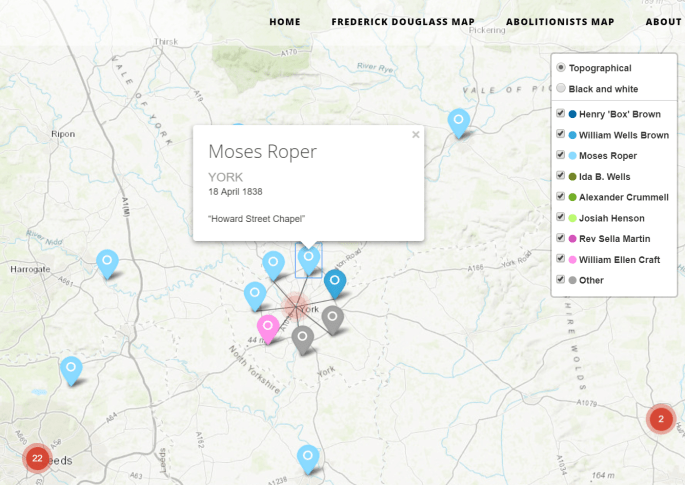
How much do you know about black abolitionists campaigning in the UK against slavery? No, neither did we until we came across this great mapping project on @twitter! Mapping black abolitionists’ speaking tours in the UK There are several people who came to speak in York. Some are hard to place, but three were in what is now the Fulford School catchment area!

In addition, there is now a map that shows local peoplewho were, now highly controversially,  compensated for their ownership of slaves by the British government.

World War One in the local area free resources

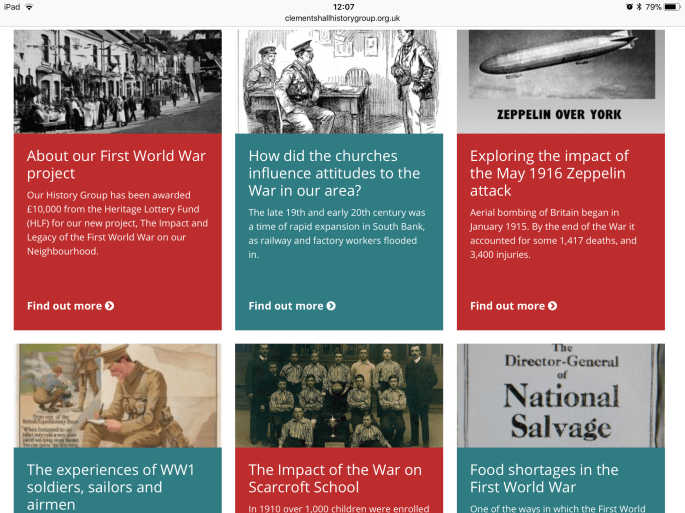
We are so lucky in York to have active and inspired local history societies. The Clements Hall Local History Group have had a lottery grant for their local World War One project. They have used it so brilliantly! The research they have done has all been published online – though there are also some hard copies of certain booklets. We can share it with you here: Clements Hall LHG World War One resources This site really is worth a look for all history teachers, but especially those around York. You will find films about a zeppelin raid and conscientious objectors. There are first hand accounts from soldiers, sailors and airmen. The role of women is explored. There is detail about how local churches, schools and organisations got through the conflict. There is also a lovely section on the Rowntree memorial Park. You can see the Quaker influence in the memorial text and it would make a lovely intro to the mood with which many greeted the founding of the League of Nations.

This park and the adjoining playing fields were given to the city by Rowntree & Co. Ltd to the memory of those members of the company’s staff who at the cost of life and limb or health and in the face of inconsiderable suffering and hardship served their country in her hour of need. Many were inspired by the faith that this war might be the end of war – that victory would lead to an enduring peace and to greater happiness for the peoples of the world. The creation of the League of Nations will be a fitting crown to the faith and hope of the men who have fought and a true memorial to their endurance, heroism, comradeship and sacrifice.”

Do have a look elsewhere on the site for other nice local history resources that would be useful for a KS3 history club.

Fulford, Fishergate and Heslington Local History group are also tracing all the men on four of their local war memorials. They have also done some work on the military buildings in their area. Here is their link: FFH Local History Group WW1

We are really grateful for all the time, effort, enthusiasm and skill that has gone into putting these resources together.

Picturing the Past

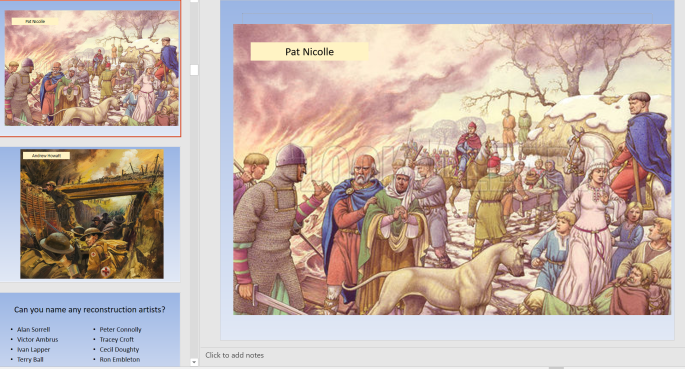
Michael Riley shared with us wonderful historical illustrations and many ideas about how to use these as historical interpretations in our classrooms. His Powerpoint and handout are here: Picturing the pastPicturing the Past handout

Teaching the Domesday Survey

Ruth Lingard and Helen Snelson from Yorkclio worked with Professor Stephen Baxter from the University of Oxford to develop resources for teaching about the Domesday Survey. The attached resources are adaptable for Key Stage 3 or GCSE and the whole lot can be done in one lesson. The story of Domesday is so exciting and some of this can be missed by students. These trialled and peer-reviewed activities should solve that problem!

Resources for learning about the Domesday Survey and the challenge facing the scribes: How revealing of Norman skill is the Domesday Survey  The first part of the story of the Domesday Survey   Eight wapentakes  Ten landholders

Resources for learning about what Domesday Book reveals about the Conquest: What can Domesday reveal re Conquest  PPT people and places on map  What can Domesday reveal places   Sheets on which to collate findings

If you want to catch up on the latest research about the Domesday Survey – here are some notes: Domesday Book

Update: huge thanks to Tracy Bowen who has adapted these resources for her Y7 students with low-levels of literacy. If you stick these A3 posters up around the room: Domesday Book Differentiated activity , students can then use them to collect the info onto this chart Domesday Book Survey – Differentiated . Here is the PPT that fits around it and sets up the lesson: Domesday Book – Differentiated Activity .

Follow this link: @HistoryBreeze  to nice examples of data capture sheets developed for use with the main activity. Thanks for sharing, colleagues!