Alford Gardner’s story is rich material for the history classroom. His story connects Yorkshire to the Windrush story, from 1948 to present day. It presents a narrative arc of Britain in WW2 to the present. Here is a Padlet of resources and suggested approaches to using Alford’s story in the classroom.
Tag: Empire
Stories of slavery, abolition, industry – York and area
Thanks to the University of York Borthwick Archives and Professor Jim Walvin, we have been focusing on York and area in connection with slavery, abolition and industry. This complex topic could be approached using a local focus. To help teachers, here is a Padlet of ideas, knowledge and resources to help with planning and teaching. There are:
- Resources relating to the two people who lived in York having been compensated for owning enslaved people – they are on the UCL Legacies database.
- Images from the Harewood Lascelles archive.
- Clips of Prof Walvin giving perspectives on abolition.
- A story from letters by a methodist missionary on Nevis at the time of abolition.
- Maps, timelines and images
- A short reading/listening list for busy teachers.
Please do let us know if there is anything you would like adding to this. The intention is not to replicate what is elsewhere, but to keep a specific local/ new focus.
Meanwhile, nearby… David Oluwale
Thank you to Kristian Shanks, Head of History at Sherburn School, for creating and sharing this Meanwhile, nearby about David Oluwale. David Oluwale was born in Nigeria, moved to Britain and lived in Yorkshire. He died after police brutality in Leeds in 1969. Meanwhile Nearby – The Murder of David Oluwale
Bristol Bus Boycott home learning resource
Thanks to Manor School in York for putting together this home learning resource for their Year 8 pupils this week and for sharing it with us #OBHD: The Bristol Bus Boycott, 1963
(featured image: by Source, Fair use, https://en.wikipedia.org/w/index.php?curid=25700828)
WW1 at Home
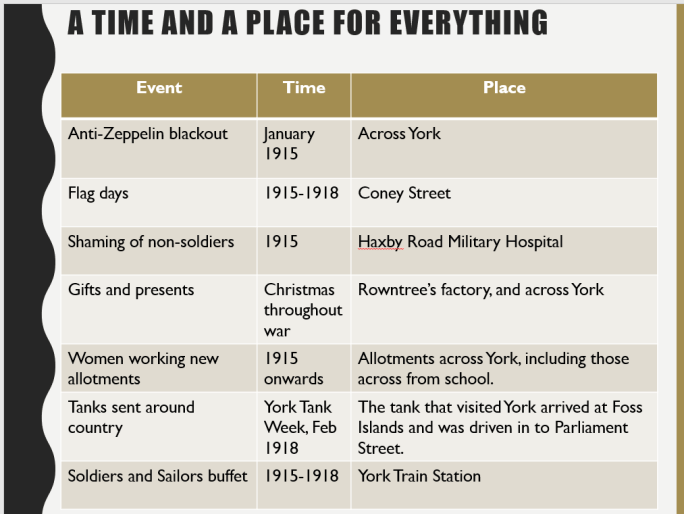
Hugh Richards has shared this PPT used by the Huntington School History department. Nice local history connection to the wider topic for York teachers re World War One.
Turning the world upside down: teaching the 17th century so that all voices are heard
This is where we will post the first person 17th Century Stories over the next couple of months.
Mary Belasye, Countess Falconberg
More coming soon!!!
If you are interested in other sets of first person resources, there are some from 1945-49 available here: historiana.eu
‘Women in War’ HA session 2019 resources
Here are the resources that were explained in the HA 2019 conference in Chester about ‘Women in War’.
The timeline thematic activity:
Women in war over time thematic
Activity using the memorial to the women of the British Empire who did in WW1
- Ask – who is remembered on World War One war memorials?
- Read Helen Little’s letter and tell the restoration story – Info here: 2019 Five sisters Restoration story and letter
- Using a map on screen of the British Empire in the 1920s (easily available online). “You are about to get a woman’s story (written and researched by students) and a post-it note. Read it, put her name on the top of the post-it and summarise her role and death in one or two sentences onto the post-it. Come and stick it onto the map wherever you think it should go .” The women’s stories are all here: Annette PrevostBertha StevensonConstance AddisonEdith BettisElizabeth Impey storyGertrude PowickeHelen CourtJessie Olive HockeyLorna Ferrislorna rattrayLouisa Blanche RiggallLouisa WoodcockMargaret CaswellMargaret LoweMarion Lapishmary carterMary Gartside-TippingNellie ClarkeNellie SpindlerViolet Barrett
- Questions:
- What roles did women have who died as a result of WW1 and are on this memorial?
- What caused their deaths?
- Where did the come from?
- What sort of women were they? (all classes, but very white!) What does this suggest about the women who were in a specific service in WW1?
- Which women in war are not represented on this memorial? (mothers, carers, civilian dead from being in a war zone eg East Africa or from a zeppelin raid in York)
- What is the limitation of using a war memorial for accessing the story of women in WW1 (only the dead – actually is similar for men too – and we need to watch this on battlefields tours!)
- How is this deepening our understanding of women in the early 20thC – networked, organised, diverse…
Activity about the role of women in WW1 from a transnational perspective
- Take an inference diagram* and work with it.
- Now pass them around and look at each others’ work (this could, of course be on the wall)
- What can we infer from the source collection as a whole?
- Which of these roles do you think would have continuity with 19thC women’s roles and which were driven by the necessities of war?
- What would you now like to know about WW1 Y9? (why not let an activity such as this drive a student led framing of the WW1 enquiry question they wish to pursue?)
2019 women WW1 sources as inference diagrams – *they are all here.
And go to the ‘slot-ins’ page of this site for Women in War ‘slot-ins’!
History of Women in 6 objects
Does your teaching reflect that over 50% of the people in the past were not male? Here is free resource a history of women through 6 objects to help you.
Inspired by the book ‘A History of Women in 100 Objects’ by Maggie Andrews and Janis Lomas, this classroom wall display has been put together by Ruth Lingard. It takes six objects, explains their past and what they reveal about the women to whom they are connected.
The ‘slot-in’ section is also growing. Check out a new addition on Mary Anning.
Quality resources about schools and WW1
A couple of really interesting resources that have come to our attention.
Firstly, a sourcebook about World War One that concentrates on the global dimension. Great for sources to show diversity and that it was, well, a WORLD War, with global impact.
Secondly, an interesting website of resources about secondary schooling since 1945. A great opportunity to build some oral history around this!
Borthwick Institute School Resource Packs
These are nice! The University oof York’s Borthwick Institute has produced these schools packs using material in their extensive archives. There are materials that can be passed on to English and Art colleagues too.
Of most interest to History teachers will be the pack on the Transatlantic Slave Trade, its links to Harewood House and the abolition debate. Local York teachers will find the Heslington Hall materials useful to flavour KS3 topics with local history.
@YorkClio and @Snelsonh had a fascinating day with the Bootham and Retreat Hospital archives – the results of that will be out soon – and you can find the Retreat archives online here too.