What sort of England did William Conquer?

Resources for this enquiry from the HA teachers’ course with the British Library re Anglo-Saxon kingdoms.

The lesson plan is here: What sort of England did William conquer lesson plan

The PPT is here: Anglo-Saxons

The sources and chart are here: Sources    Chart for sources  

Teacher crib sheet for source chart

Sources back up Baxter sheet

The interpretations are here:

Baxter balance and faction intBL blogpost intHenry poetry intLacey consent and creativity intLacey life tough intLacey prop USA intMorris church intWood on what is lost intWood rights and property intWood women int


YHF Resources: Thomas Becket session

The teaching materials that were presented in November 2018 at Yorkshire History Forum are here for your use. York PGCE medieval religion lessons-FINAL

They are:

  1. An activity about religion in medieval life with plan, resources and subject knowledge for teachers.
  2. Two lessons about Becket, with resources and subject knowledge for teachers.
  3. A fully resourced lesson on the rivalry between York and Canterbury that was fueled by the Becket affair with an impact on the historic environment still evident today.
  4. A lesson on medieval pilgrimage with teacher plan, resources and subject knowledge update.

These materials were developed by the University of York PGCE historians 2017-18. To do this they worked with Jeremy Muldowney from York Minster and with Dr John Jenkins, University of York and other members of the Centre for Christianity and Culture. The materials were edited by Helen Snelson.


meanwhile, elsewhere…

If you haven’t yet found it, here’s a wonderful resource crowd-sourced from history teachers across the country. Richard Kennett (@kenradical) had the great idea to use KS3 homework time to get kids to find out what was going on somewhere else at the same time as the events they were studying in class. A brilliantly simple way to get breadth into a jam-packed curriculum. Will Bailey-Watson (@mrwbw) then suggested a crowd-source of these and has acted as co-ordinator and editor. The results are being posted on the website ‘meanwhile, elsewhere..’ and are free for everyone to use.


Resources for Schools from Oxford University

“How do we create a curriculum in schools and universities that best reflects the histories of our current students and future citizens? As Britain has become a more diverse society, and as a result become increasingly aware of its diverse past, the need to ensure that is reflected in what we teach and research is a question of growing importance, educationally and politically.”

That’s the start of the blogpost that explains the thinking behind the new resources for schools trial from Oxford University. You can read the blogpost HERE

The result of this thinking so far is the development of knowledge rich resources that are not focused on the British Isles, or even Europe. This site is worth exploring to expand your own subject knowledge, for resources you can use and adapt for use in class, for ideas about more diverse approaches to school history topics.

The resources team would welcome comments via the website.

Hidden in Plain Sight – resources for teaching the history of people with disability

Following on from our HA conference session in Stratford, here are the copies of the resources. We have a duty to reflect the pasts of all people in society in our classrooms. Our session focused on subject knowledge about the history of disability and ideas for teaching. We worked with a mini-thematic activity exploring disability through time. You can find a Word file of these resources here: Timeline headings and text  Pics for timeline

We suggest that you can first match headings and pictures, then sort the material onto a timeline, then ask questions about continuity and change in attitudes. For example, how complex are attitudes across the medieval period? When was the worst time to be a person with disability in the past? What is the role of factors such as religion, the state, war etc in the story.

This sort of mini-thematic could be used at KS3 (to help students learng to think thematically) or at the start of teaching ‘Medicine Through Time’ (as it explores some very relevant themes to that topic).

The image featured on this blog is a Bruegel called ‘Carnival and Lent’. We ask students to imagine walking through the scene noticing the people. Disability is not hidden away.

We have also developed the idea of ‘slot-ins’. Recognising that the history curriculum is jam-packed, we want to encourage you to recognise the stories that are within the topics you already teach. Slot-ins (not bolt-ons) allow you to introduce richness and diversity to topics from the Tudor court, to slavery abolition, and to civil rights post 1945. You can find these materials here.

Thanks to the team who worked with us yesterday and please do share great ideas for bringing more of these important pasts into our history lessons.

Another useful timeline is here: Disability timeline

Why is Europe so many different countries?

Reading Tim Marshall’s Prisoners of Geography over the Easter holidays developed my thinking and questioning as to why certain countries perpetually seemed to be at war. I always knew that France and Germany had historic disagreements, but never stopped to consider how the physical geography of the countries, combined with individuals’ desire for power, could influence this.
With this in mind, I created this two-lesson sequence, aiming to draw together elements of historical and geographical teaching in a way to help develop students’ schema of the medieval period, as well as to understand why countries perpetually seem to be at war. It is designed for Year 7, which is why I have combined some regions (notably France) into more of a nation state than it was.
As a non-geography expert, I am sure that there are many elements of the discipline that I could have included but did not. If you happen to think of any ways to improve this resource, please let me know.
The resources are here:
Victoria Bettney
University of York/Pathfinder TSA trainee 2017-18 and York High from September 2018

When did William conquer England?

Now there’s a big question for a Friday afternoon! Attached here are a couple of resources that you can use to help students decide. Hugh, who developed these, recommends a dramatic intro for each scenario:

  • Was it when he was out of breath on the top of Senlac Hill?
  • Was it as he sat smugly in the charred remains of York Minster?
  • Or was it…?

Students create a situation report for each scenario. When did William Conquer England

And, in case you need it, a crib sheet to get you started: MASTER – When did William Conquer England

Picturing the Past

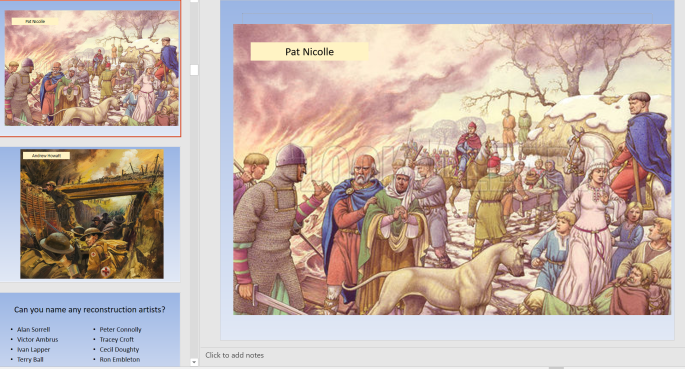
Michael Riley shared with us wonderful historical illustrations and many ideas about how to use these as historical interpretations in our classrooms. His Powerpoint and handout are here: Picturing the pastPicturing the Past handout

Teaching the Domesday Survey

Ruth Lingard and Helen Snelson from Yorkclio worked with Professor Stephen Baxter from the University of Oxford to develop resources for teaching about the Domesday Survey. The attached resources are adaptable for Key Stage 3 or GCSE and the whole lot can be done in one lesson. The story of Domesday is so exciting and some of this can be missed by students. These trialled and peer-reviewed activities should solve that problem!

Resources for learning about the Domesday Survey and the challenge facing the scribes: How revealing of Norman skill is the Domesday Survey  The first part of the story of the Domesday Survey   Eight wapentakes  Ten landholders

Resources for learning about what Domesday Book reveals about the Conquest: What can Domesday reveal re Conquest  PPT people and places on map  What can Domesday reveal places   Sheets on which to collate findings

If you want to catch up on the latest research about the Domesday Survey – here are some notes: Domesday Book

Update: huge thanks to Tracy Bowen who has adapted these resources for her Y7 students with low-levels of literacy. If you stick these A3 posters up around the room: Domesday Book Differentiated activity , students can then use them to collect the info onto this chart Domesday Book Survey – Differentiated . Here is the PPT that fits around it and sets up the lesson: Domesday Book – Differentiated Activity .

Follow this link: @HistoryBreeze  to nice examples of data capture sheets developed for use with the main activity. Thanks for sharing, colleagues!